
Indio moves closer to permanently banning data centers
On the current timeline, a permanent ban could be in place as early as October.
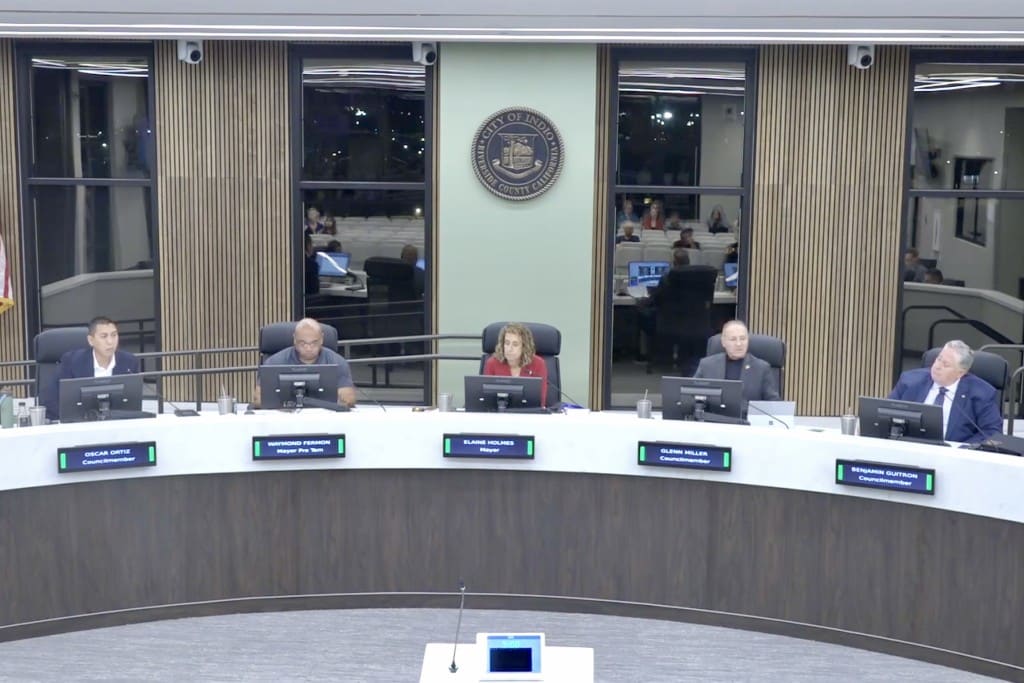
The Indio City Council voted unanimously Wednesday to extend the city’s moratorium on data centers for 90 days and direct staff to draft a permanent ban on the facilities in all zoning districts.
The vote extends the urgency ordinance through Oct. 16. It follows a unanimous recommendation from the Planning Commission on June 24 that the city adopt a complete ban.
Before Councilmember Oscar Ortiz made the motion, he said, “I do acknowledge the potential benefits in construction jobs and tax revenues.”
“But I don’t think that these outweigh the risks of drastically increasing our consumption of water and fossil fuels, potentially contaminating our air and our water supplies, and potentially exposing our population and wildlife to the impacts of constant low-frequency noise and other environmental impacts and currently unknown impacts,” Ortiz concluded.
He said even as a chemist he is still learning new information about the data centers and their impacts.
Community Development Director Brian Halvorson told the council the city has not received any applications for data centers, but presented research showing hyperscale campuses can span 100 to 300 acres, use 500 megawatts to more than 1 gigawatt of power, and consume 300 million to 1.5 billion gallons of water annually.
Halvorson outlined several paths forward, including amending the General Plan to prohibit “resource-intensive uses” in Workplace and Employment Districts, amending the Unified Development Code to ban data centers outright in all zones, or requiring conditional use permits and development agreements instead.
Councilmember Glenn Miller, recalling a recent moratorium on gas stations where the city could not ban all new gas stations, asked if it would be possible to ban data centers outright, “without any concern.”
The city attorney responded that a prohibition would be defensible “as long as the prohibition is supported by appropriate findings.”
Seven people addressed the council on the item. Six urged a permanent ban and one asked the council to consider a regulatory approach instead.
Elizabeth Humphreys, an Indio resident and president of the American Data Center Research and Education Foundation, told the council that a hyperscale data center employs about 50 permanent workers on average, citing a study by the nonprofit Good Jobs First.
“I hate to see all this wonderful growth that Indio has had over the past few years just demolished by having one of these in our communities,” Humphreys said.
Another resident said rising temperatures near hyperscale facilities worry her because her parents and grandparents, who have health issues, plan to retire in Indio. “I know a lot of people that are pro AI, a lot of people that are anti AI, but I don’t know anyone that’s pro data center here,” she said.
Cherie Cabral, representing the Western Steel Council and the California Construction Labor Management Trust, said the council should consider regulation rather than a blanket ban.
“I think enacting the unilateral moratorium effectively says that no facility has merit, and I don’t think that’s the case,” she said.
Staff said that if the council decided on a full ban, the draft ordinance would go to the Planning Commission in August, return to the council in September for two readings, and take effect roughly 30 days later, with the prohibition likely in place by the end of October or early November.
Author

Related Articles

Indio adopts new rules targeting vacant commercial buildings
“If you’re going to invest in Indio, maintain your property,” Councilmember Ben Guitron said during the Wednesday meeting.

Indio’s first independent bookstore coming to former Oasis on Miles music venue
The store would serve as a community-focused literary and cultural hub, hosting author events and arts programming while offering books and merchandise.

Indio Monroe Street freeway interchange clears milestone as officials set cost-sharing rules for cities
Officials say a major $181 million overhaul of the Interstate 10 interchange at Monroe Street is on track for a January construction launch.