
Indio enacts emergency ban on data centers as city works to craft long-term policy
Indio halts new data centers for 45 days as residents in neighboring Coachella protest massive tech campuses over water and power concerns.
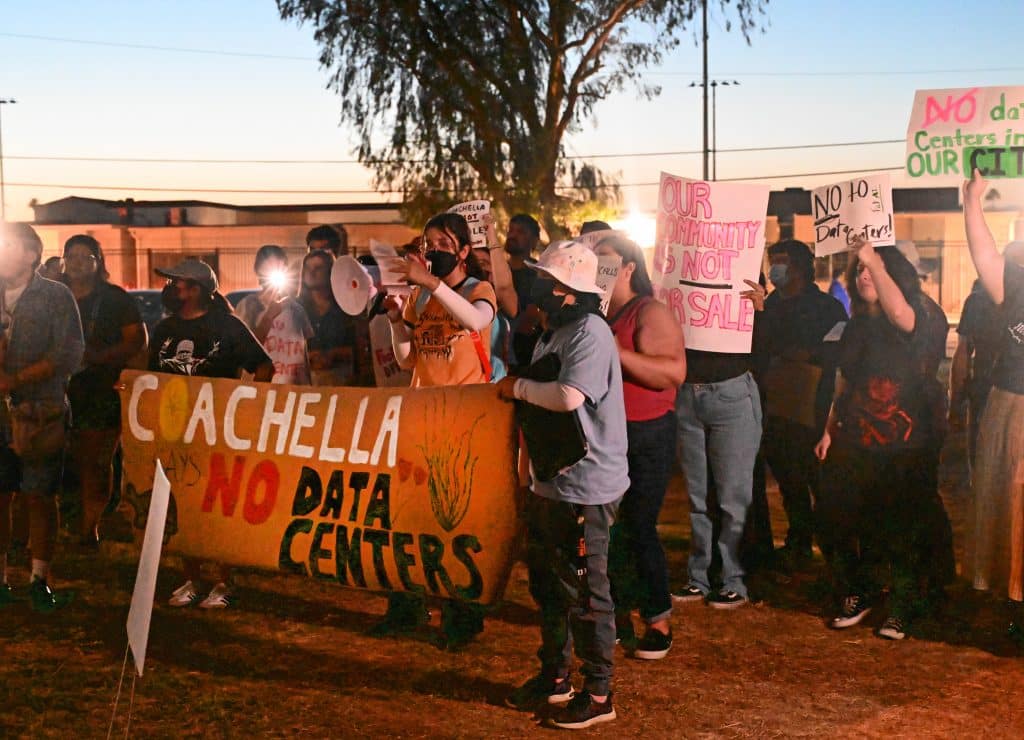
The Indio City Council voted Wednesday to impose an emergency 45-day moratorium on data centers, joining a regional debate over large-scale computing facilities that has drawn hundreds of protesters to a neighboring city’s council chambers.
The council voted 5-0 to adopt an urgency ordinance halting the establishment, expansion, or intensification of data centers and similar high-intensity computing uses within city limits, effective immediately through July 18.
The action comes as the city of Coachella is set to meet Thursday to consider its own urgency ordinance to initiate a moratorium process, one day after Indio acted.
That discussion follows a series of Coachella City Council meetings that drew hundreds of residents opposed to a proposed development known as the Coachella Valley Technology Campus — a project that could grow to 450 acres and include six data centers under a municipal utility agreement between the city and Stronghold Power Systems Inc.
In Indio, Councilmember Oscar Ortiz initiated the urgency request, citing community concerns.
“Many of our families have expressed to me that they don’t want to see that increase of demand on fossil fuels or increase of demand on water for the purpose of artificial intelligence,” Ortiz said.
The moratorium was added to Indio’s agenda at the start of Wednesday’s meeting, requiring a four-vote supermajority to place it before the council. The item was drafted by the Steven Graham, city attorney, during the meeting itself, modeled on moratoriums the city has adopted in recent years on self-storage sites and gas stations.
The ordinance defines a data center broadly to include any facility used primarily or substantially for housing computer servers, data storage devices, networking equipment, cloud computing, co-location services, artificial intelligence model training, blockchain operations, cryptocurrency mining, or other similar high-intensity computing uses.
Exceptions include customary server or IT rooms incidental to a business’s primary permitted use, ordinary office, retail, school, and hospital functions, public safety and emergency communications facilities, and telecom carrier facilities. Graham confirmed that any applicant with vested rights to develop is not affected by the moratorium.
City staff confirmed that so far, there were no developers seeking to build a data center in the city.
“We may not have any in the pipeline,” Mayor Pro Tem Waymond Fermon said, “But Indio is the biggest city in the Coachella Valley. We have the most land, and that wouldn’t preclude [developers] from at least putting an application in,” he said.
He said quick action was necessary, especially after developers moved to put in gas station applications before the recent moratorium.
“I’m not comfortable leaving any opening for anyone to put an application in,” Fermon said.
Ortiz said the pause was also meant to protect developers from investing time in applications the city may ultimately reject.
“We also don’t want developers to waste their time,” he said. “If we’re going to be having a conversation in 45 days on how to regulate these, then let’s hold off on taking those applications in.”
A broader data center policy is scheduled to go before Indio’s Planning Commission on June 24 before returning to the full council, expected July 15. The council also directed staff to include options for a long-term moratorium or a permanent ban when the matter returns for consideration.
Author

Related Articles

Coachella Valley survey shows lean toward transit coverage over speed, as SunLine plans for bus route overhaul
In a community survey a slight majority favored more bus service that covers a wider region rather than faster routes.

Indio detached home prices dip to $607,000 as condo market drops 13%
Single-family home prices in Indio fell 3% over the past year, while attached home prices tumbled 13% to a median of $286,000.
Indio commissioners back new rule that could boost affordable housing
As the only Coachella Valley city with a state Pro-Housing Designation, Indio is aligning its local code with California law to offer extra building incentives for affordable housing.