
Data center town hall turns contentious as residents from across the valley demand answers
Frustration boiled over as more than 100 attendees at a meeting in Coachella challenged city officials and project representatives over water, noise and climate concerns — and whether key decisions had already been made.
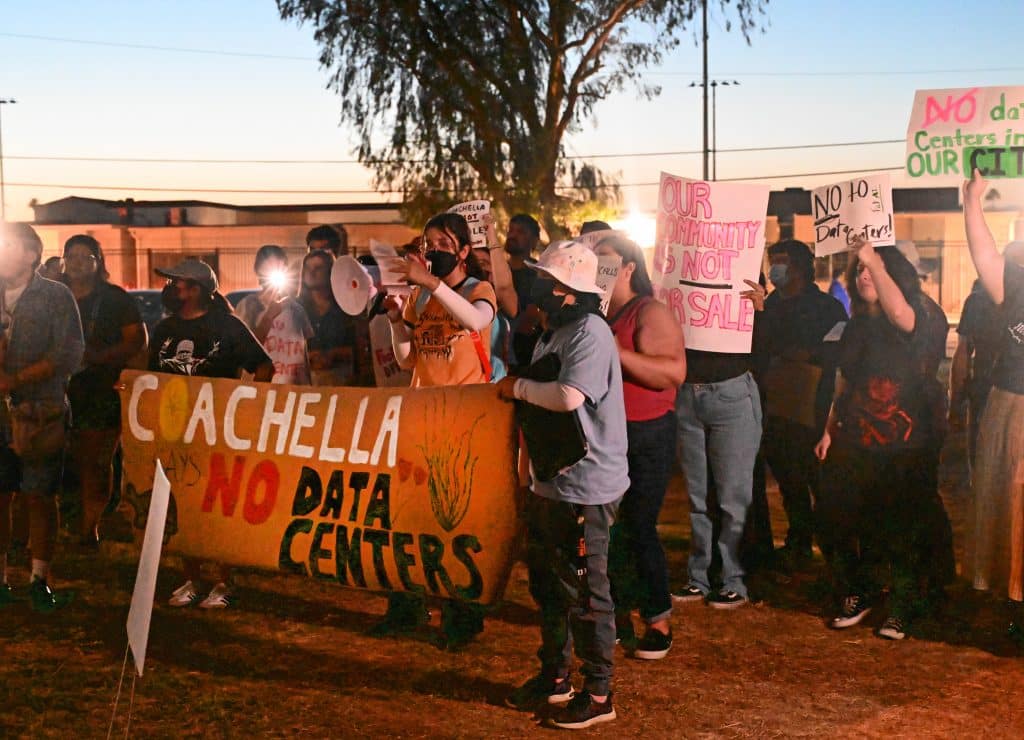
A community town hall Monday night in Coachella was supposed to give concerned residents answers about a proposed data center project, but instead left many frustrated and accusing city officials and project representatives of avoiding direct questions.
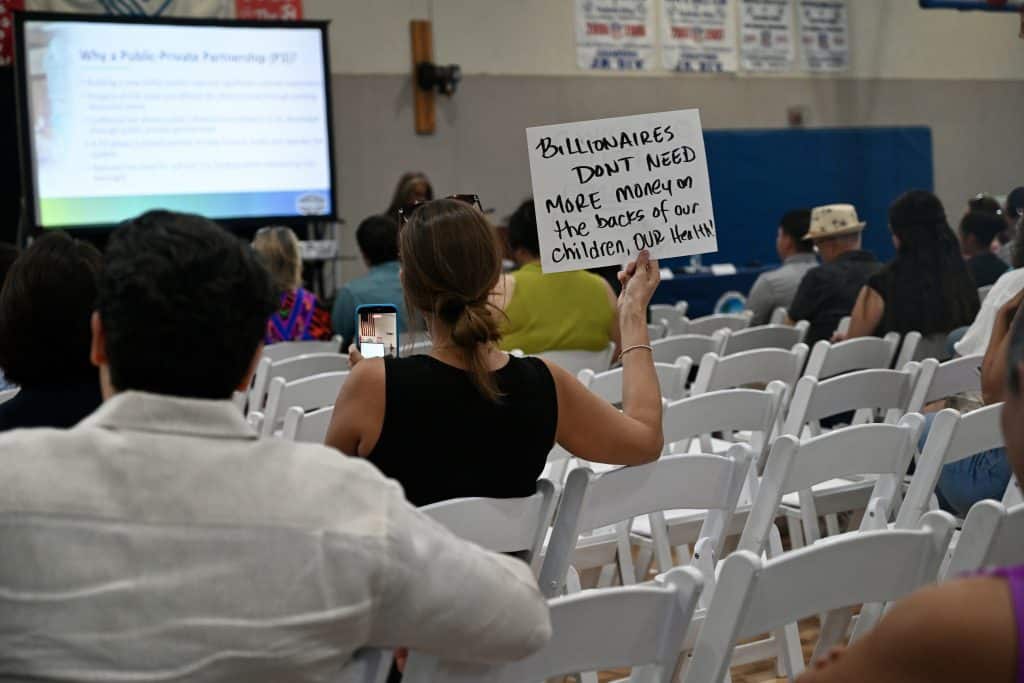
More than 100 residents from communities spanning Sky Valley to Palm Springs packed the Boys & Girls Club for a meeting focused on the proposed Coachella Valley Technology Center Campus, a planned 450-acre project at the intersection of Fillmore Street and 52nd Avenue.
The project is divided into two phases. Phase 1 would include a 240-acre technology campus with three microgrids, an energy center and three data center halls consuming between 270 and 300 megawatts of power. A proposed Phase 2 expansion would occupy another 210 acres and consume an additional 300 megawatts.
One megawatt is enough to power about 1,000 homes, according to Imperial Irrigation District (IID). City documents estimate the entire city of Coachella’s projected 20-year electrical load is just 70 MW.
Before the meeting, more than a dozen people gathered outside with anti-data center signs. Inside, residents interrupted presentations, challenged speakers and at one point used their phones to amplify what they said was audio recorded near data centers.
Communities nationwide have reported a constant low hum coming from some data centers, often tied to cooling systems, fans or backup generators.
Throughout the evening, city representatives repeatedly emphasized that no formal data center project has been approved.
“As of today, no data center project has been approved,” said Beatrice Eslamboly of CV Strategies, the consulting firm hired by the city to facilitate the meeting. “No environmental impact report has been completed and certified yet, and no project application has been approved by a planning commission or city council.”
Conceptual plans or a foregone conclusion?
Many residents questioned that characterization, pointing to actions already taken by the city and project partners.
City records show the Coachella City Council voted unanimously Feb. 11 to approve a Municipal Utility Development Agreement with Coachella Valley Power Services LLC, a subsidiary of Stronghold Power Systems Inc.
The public-private partnership would allow Stronghold to finance and develop new electrical infrastructure intended to serve eastern Coachella.
Eslamboly said the city has planned infrastructure expansion in that area for years, but pursuing upgrades solely through IID would have been “extremely expensive.”
Though plans for the data center were included in staff reports presented to councilmembers, Eslamboly described them Monday as “conceptual,” saying the council approved only a framework for future infrastructure development.
But comments made during the Feb. 11 council meeting painted a more advanced picture of the project.
Jonathan Avila, Stronghold’s business operations director, described the data center as the “anchor tenant” for the future utility system and discussed timelines for construction and environmental review.
“The first process [would be] building up the utility for the 24 acres that will primarily serve the data centers themselves,” Avila said during the February meeting, adding that the company was already pursuing entitlements and rezoning for the site.
Avila also said Stronghold expected to complete California Environmental Quality Act review by the end of the year, begin construction next year and complete Phase 1 by 2029.
Stronghold CEO Scott Bailey told councilmembers in February that the company already had “notable partners” lined up to operate the data centers and highlighted the potential financial return for the city.
“There’s just so many layers of opportunity,” Bailey said at the time. “The utility itself is basically producing 8% of gross revenues that are coming back to the city. And if you start doing the math out of what these data centers will consume, that’s a good chunk of money.”
City officials said planning for expanded utility infrastructure dates back more than a decade, with eastern Coachella identified as a growth area in 2015. The city voted in 2019 to pursue creation of a municipal utility and later commissioned feasibility studies before issuing a request for proposals.
On May 14, 2025, the three councilmembers present voted to award the utility contract to Stronghold.
County records show that less than a month later, on June 3, Stronghold purchased the first three parcels planned for Phase 1. A fourth parcel was added in October, bringing the company’s total land investment to roughly $17.3 million.
While the Phase 1 site is currently zoned for irrigated farmland, the developer and city have been working to pivot the property toward industrial use. The proposed Phase 2 expansion area — which Stronghold has not acquired — is currently zoned for date gardens, citrus groves and table grape vineyards.

Officials pressed on climate, noise, water
Many of the sharpest exchanges Monday came during the question-and-answer portion of the meeting, when residents repeatedly pressed officials for specifics on water consumption, electrical demand, noise pollution and climate impacts.
Representatives from the city, Stronghold and legal counsel frequently responded that detailed answers could not yet be provided because no formal project application has been submitted or certified.
“I know that many people in this room are frustrated,” Eslamboly said at one point before warning attendees multiple times that she could end the meeting if disruptions continued.
Later, three Riverside County Sheriff’s deputies escorted a young woman from the room.
Residents referenced national controversies surrounding large-scale data centers, including reports of water consumption issues in Georgia and concerns about fast-tracked projects in other states bypassing environmental review.
When asked about potential climate impacts, Stronghold general counsel Dan Rasmussen said “technology is remarkable these days” and suggested future impacts could be mitigated.
Panelists also repeatedly emphasized the project’s potential economic benefits for Coachella.
“[I]f you start doing the math out of what these data centers will consume, that’s a good chunk of money.”
— Stronghold CEO Scott Bailey
“Reliable infrastructure is necessary if the city wants to continue to grow, work, and attract investment, support jobs, [and] provide services for future residents and businesses,” Eslamboly said.
Rasmussen said Stronghold and the city expect to release economic forecasts tied to the project in the future.
Other residents questioned whether the proposed development could drive up utility costs across the valley, referencing reports from communities near other large-scale data center developments.
Eslamboly said current residents are served by IID and that those rates are separate from the proposed Coachella Municipal Utility.
“The municipal utility is intended to serve the new communities in the future Coachella,” she said.
A valley-wide debate
The tension inside Monday’s meeting reflected a broader debate unfolding across the Coachella Valley over the potential arrival of large-scale data centers and the strain they could place on water and power resources.
Indio City Councilmember Oscar Ortiz attended the meeting and said he came to hear residents’ concerns and learn more about the proposal.
At the most recent Indio City Council meeting on May 6, Ortiz asked city staff to explore a policy requiring projects with high water use, high energy demand or significant land impacts — including data centers and warehouses — to go through a development agreement process.
“Sometimes cities, we get stuck when something fits the right zoning and they have the right permitting, you have to let them through,” Ortiz said Monday.
He described the proposal as a proactive first step that would allow more public review of future projects.
As residents filed out of the meeting chanting “Shame!” officials encouraged attendees to complete a public survey related to the project.
Author

Related Articles

Indio police to get more drones for CV Link patrols
The extra drones come amid a valley-wide push for more surveillance tech like Flock cameras.
Indio targets $27.5M state grant for solar homes, EV chargers, and new trails
After a failed earlier bid, Indio is revamping its strategy for a multimillion-dollar state climate grant that could fund solar, EV charging, walking trails and other green projects.
Riverside County approves $10.3 billion budget, drawing on reserves as departments warn of funding gaps
From pauses in hiring countywide to the future of senior meal programs, Riverside County’s newly approved $10.3 billion budget reveals how deep funding gaps will force tough choices on local services.