
Valley Sanitary District outlines ambitious plans for the future as it celebrates 100 years
The district’s most ambitious project involves converting sewage sludge, or biosolids, into liquid fertilizer for local farming operations, eliminating the need to truck biosolids to Arizona where it’s transformed into compost or fertilizer.
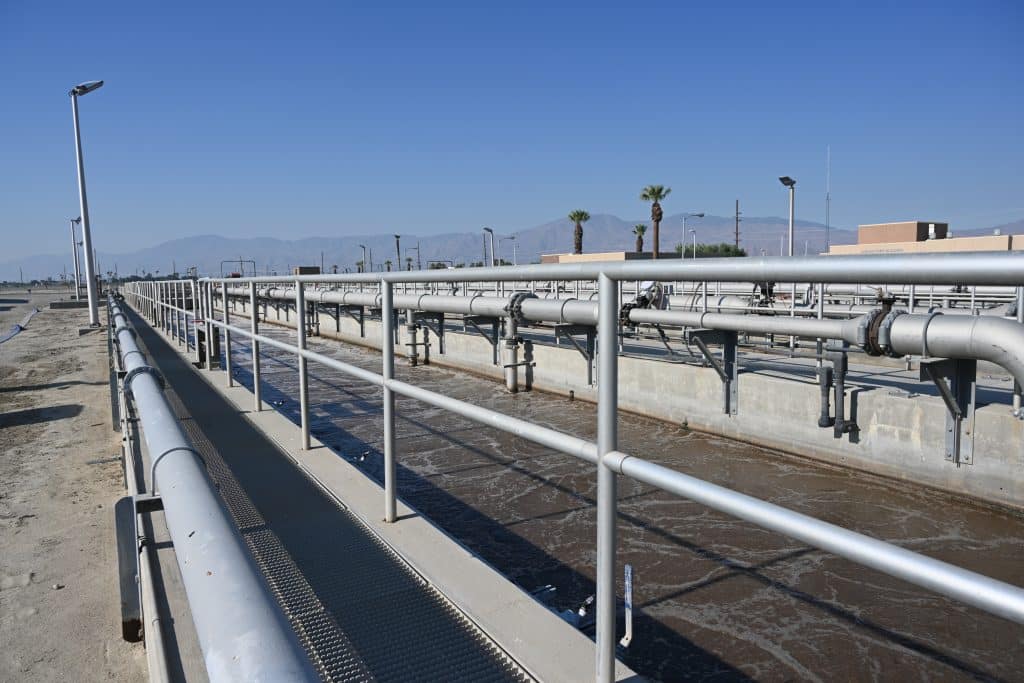
The Valley Sanitary District is celebrating its 100-year anniversary this November and looking to the next century with plans for four innovative projects that will modernize its wastewater treatment system and develop the next generation of industry professionals.
The district was established in 1925, five years before the city of Indio was incorporated. At the time there were about 1,000 residents in what would become Indio, mostly employees of citrus and date ranches and the railroad.
“100 years ago, they realized that outhouses were contaminating the groundwater,” General Manager Jason Dafforn said. “That’s usually how it all starts, when there’s an issue on the water side.”
100 years later the district serves more than 91,000 residents in Indio and parts of Coachella, La Quinta, and unincorporated areas of Riverside County and processes about 6 million gallons of wastewater daily.
“We’re celebrating a huge milestone for the district,” Dafforn said during a recent facility tour. “Not many people can say that.”
The district’s most ambitious project involves converting sewage sludge, or biosolids, into liquid fertilizer for local farming operations, eliminating the need to truck biosolids to Arizona where it’s transformed into compost or fertilizer.
Dafforn said the district could take on a leadership role with this project as it would be the first district in Southern California to use the process.

“Everybody sends it to Arizona because it’s the cheapest,” Dafforn explained. “Eventually, it’s not going to be the cheapest.”
He said the Arizona legislature has considered state regulations that could make the disposal process more expensive in the future. Transitioning to the liquid fertilizer method is a way to control more of the process and keep the fertilizer in the community.
The biosolids project is nearing the end of its design phase.
A second project aims to capture treated wastewater currently discharged into the Whitewater Storm Channel and convert it for golf course irrigation.
The plan is to take about one million gallons a day of wastewater that’s already been treated, treat it one more time, and then use the water on local golf courses. The plan would take strain off the valley’s groundwater supply by using non-potable water in place of potable drinking water. That project will soon be in the feasibility study phase.
Two more projects include a new laboratory building to be outfitted with “the latest and greatest technology” to keep the district on top of the complex testing needed for state environmental regulations and a new training and office building that could provide more opportunities for young people.
“We see a great opportunity and lack of resources for our local younger generation to get involved,” Dafforn said. “This industry has opportunities. We have chemists, engineers, accountants, customer service folks, HR, and different departments just like any other business.”
“This industry has opportunities. We have chemists, engineers, accountants, customer service folks, HR, and different departments just like any other business.”
— General Manager Jason Dafforn
The training facility would help expand those opportunities and could enable partnerships with local schools like College of the Desert.
The new projects come on the heels of a recently completed $80 million upgrade to several treatment plant components, including additional bar screens, a circular grit chamber, and a second digester.
Dafforn said the new projects, funded through ratepayer fees and state and federal grants, represent the same forward-thinking approach that led to the district’s formation a century ago.
“We want to control our own destiny,” Dafforn said. “At the end of the day, that’s what it’s all about, making sure we’re not breaking the backs of our ratepayers.”
Author

Related Articles

Indio police to get more drones for CV Link patrols
The extra drones come amid a valley-wide push for more surveillance tech like Flock cameras.
Indio targets $27.5M state grant for solar homes, EV chargers, and new trails
After a failed earlier bid, Indio is revamping its strategy for a multimillion-dollar state climate grant that could fund solar, EV charging, walking trails and other green projects.
Riverside County approves $10.3 billion budget, drawing on reserves as departments warn of funding gaps
From pauses in hiring countywide to the future of senior meal programs, Riverside County’s newly approved $10.3 billion budget reveals how deep funding gaps will force tough choices on local services.