
Indio Planning Commission backs contract changes to clear way for Citrus Ranch sale
Third amendment would change financial and procedural terms, not what can be built, and the buyer’s representative says the company won’t purchase the property without it
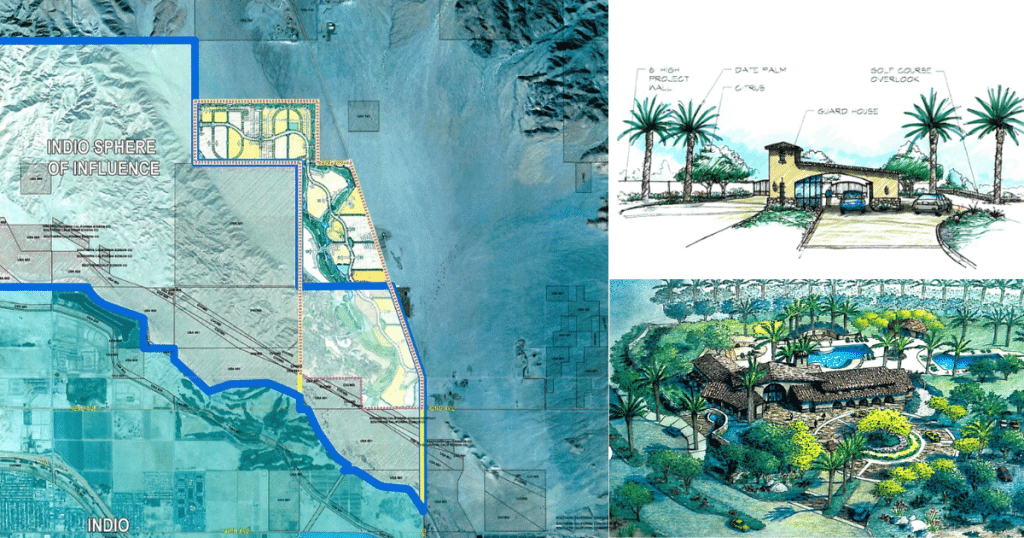
The Indio Planning Commission on Wednesday recommended that the City Council approve contract changes tied to the pending sale of Citrus Ranch, a 1,183-acre North Indio property approved for development in 2007.
The changes are not a go-ahead for construction. The third amendment to the property’s development agreement, requested by Robson Encore LLC, which is under contract to buy the land, covers only financial, procedural and administrative matters.
It does not change land uses, density, design standards or phasing, and the city keeps its discretion over future project changes. The council would need to approve it by ordinance after a public hearing.
The Citrus Ranch Specific Plan, approved in 2007, calls for roughly 3,075 homes, a golf course, clubhouse and hotel on land west of Dillon Road.
In August the City Council added a 20-year extension option to the agreement, tied to specific requirements including completion of the golf course, clubhouse and 200 residential units.
A representative for the buyer told commissioners the company “would not buy the property unless we can get these things changed in order to make this project work financially.” If the purchase doesn’t happen, he said, the agreement “stays the way it is,” and the second and third amendments never take effect.
Speaking to the decades-long delay, the representative said the project “sat on the shelf for a long time.” Infrastructure costs are “magnitudes higher than were planned 20 years ago,” he said, and power and sewer capacity the project was counting on has been used up.
Sewer is the biggest obstacle, he said. Back in 2007, Valley Sanitary District would have had the capacity to accommodate the project. “Fast forward 20 years, they’re at max capacity…and expanding their facility would be challenging.”
Meanwhile, connecting to Coachella Valley Water District instead would require a $74 million fix, making that “a non-starter.” He said the buyer is weighing a connection to Coachella’s system, which he said has capacity and hopes to resolve the issue in four to six weeks.
He said the payoff of developing the land would extend beyond the site. Building power, sewer and water lines there would “open up the city to be able to develop more and potentially annex more into the city.”
On financing, he said the city would not be paying. If a community facilities district is formed, the project must provide $15 million to the city. The buyer wants that money to go toward the project’s infrastructure instead, and the council will decide. Homeowners would repay the bonds through property tax bills, “just like you have at Terra Lago and other projects throughout the city,” he said.
The second amendment, approved by the council July 15, confirmed the agreement’s initial term ends July 26, 2032, and allows an additional 20 years if the developer meets benchmarks. According to the staff report, those include either investing at least $10 million in qualifying infrastructure or completing the golf course, clubhouse and 200 residential units.
The representative said the benchmarks mean the buyer cannot sit on the land.
“If this project doesn’t get developed soon…let’s say we don’t buy it, somebody may sell this off just to be conservation land,” he said. “That might not be the best use of the land for the city because you might want to have something developed there,” he said.
Commissioners pressed for more public benefit, like a public golf course.
The representative said the buyer builds private country clubs and “their plan doesn’t work if this is a public course.” Whether it stays open to the public will be “a business decision by the operators, not a mandate by the city,” he said.
Asked about other public features, he said none have been proposed. Changing the plan would require new environmental review, he said, which would take too long. Questioned about a community center included in the original plans, he said the buyer would likely have to revisit such issues after closing escrow. “Maybe they build the project as it is, but we certainly don’t want to get ahead of ourselves in the process at this point,” he said.
Another commissioner suggested a public driving range or restaurant. Franz closed the item by urging the developer to consider a public benefit before breaking ground. “I’m sure we’ll see you again before this is ever finished,” she said.
Author

Related Articles

Indio single-family home prices take a slight hit while condo values drop 14%
A new housing report shows single-family prices down to $595,000 in Indio, even as neighboring communities like La Quinta and Bermuda Dunes see market gains.

Indio’s State of the City highlights new civic center, sports park and neighborhood projects
From the rebuilt Avenue 44 bridge to new electrical substations, Indio officials highlighted aggressive infrastructure growth Thursday.
Indio scales back state climate grant bid to $5 million development request
The city pivoted from a $27.5 million ask to a smaller grant with a smaller scope that could affect two neighborhoods, the Jewel and Sun Gold communities.