
Assemblymember brings state agencies to Coachella Valley for senior scam seminar
With older Americans losing a staggering $7.7 billion to fraud last year, a multi-agency panel held locally revealed how modern scammers use easily available tech and psychological manipulation to exploit loneliness.
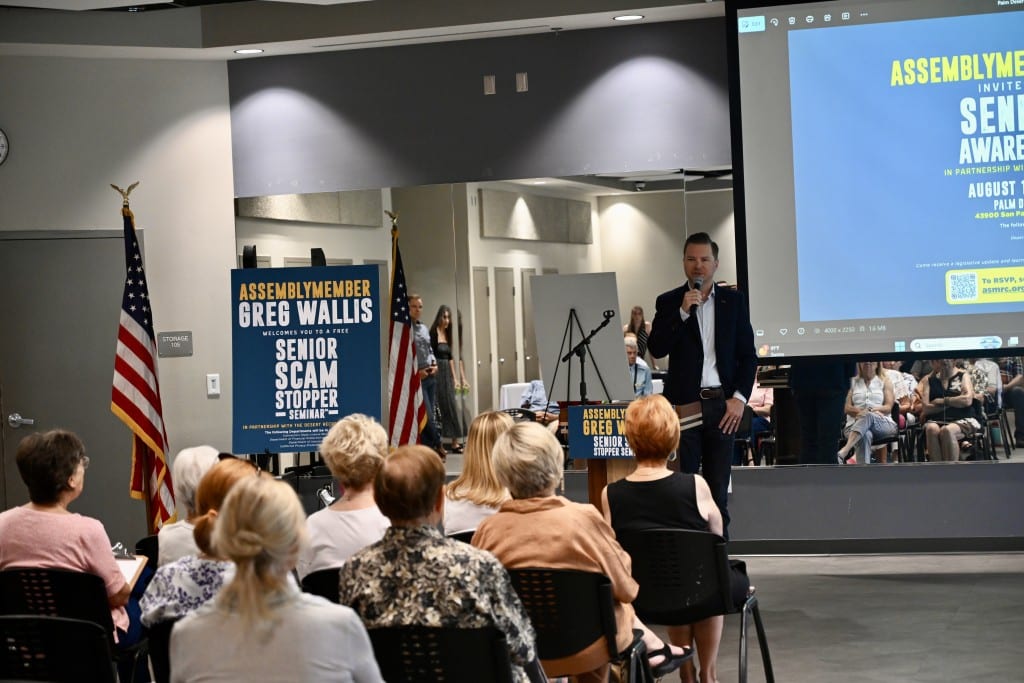
Four California agencies joined Assemblymember Greg Wallis to warn Coachella Valley seniors about increasingly sophisticated financial scams, from romance scams to contractor fraud.
Wallis, who represents the 47th Assembly District, hosted the eighth installment of his senior scam awareness seminar series at the Palm Desert Community Center.
Wallis said he started hosting scam-awareness events after his grandfather nearly wired $15,000 to scammers who convinced him Wallis had been kidnapped in Mexico. He said the series was organized to give constituents tools to protect themselves as fraud tactics grow more advanced.
“These scammers are getting more and more sophisticated, and as technology continues to advance, the scams are getting to the point where really does feel like this is a real life situation,” Wallis said.
Wallis also acknowledged the event carried a heightened sense of urgency following a recent tragedy in nearby Bermuda Dunes. In that case, 79-year-old resident Karen Whitaker was targeted by an online scammer posing as actor Tom Selleck, resulting in devastating financial losses before she and her husband died in a suspected murder-suicide in May.
Joy Miedecke, a close friend of the couple, spoke at the seminar to describe the tight hold the fraudster maintained over Whitaker, even after multiple interventions by family members, Adult Protective Services, and local sheriff’s deputies.
“She looked at all of it, and she listened, and at the end of it, she stood up, and she said, ‘I feel really bad about this, but mine is real,’ and so we couldn’t talk her into not believing it,” Miedecke said.
Wallis emphasized that the vulnerability crosses all professional and social demographics. “It can happen to anyone, it can happen to folks who are very involved in the community, very well educated, very highly intelligent folks,” Wallis said.
Four presenters spoke at the seminar, representing the California Department of Financial Protection and Innovation, the California Contractors State License Board, the California Department of Insurance, and the California Privacy Protection Agency.
The seminar highlighted the reality that financial victimization is not a reflection of a person’s education, but rather a reflection of the predator’s sophisticated manipulation tactics that exploit victims’ good nature or loneliness.
Kyra Hall with the Contractor’s State License Board said scammers trying to get seniors to sign on to a bogus contract purposely try to create a false sense of pressure or take advantage of their desire for a human moment, “To want to shake a hand, to talk to someone, that is a beautiful human quality. We never want that to change in our society, but we also want you to be protected,” she said.
Hall’s presentation focused on construction fraud, including door-to-door sales tactics and warning signs when hiring contractors while another covered common insurance scams targeting seniors, including staged auto accidents and fraudulent annuity sales.
Presenters also addressed newer safeguards that went beyond opting out of cookies and choosing safe passwords, including setting a family safe phrase to verify a relative’s identity against AI voice-cloning schemes.
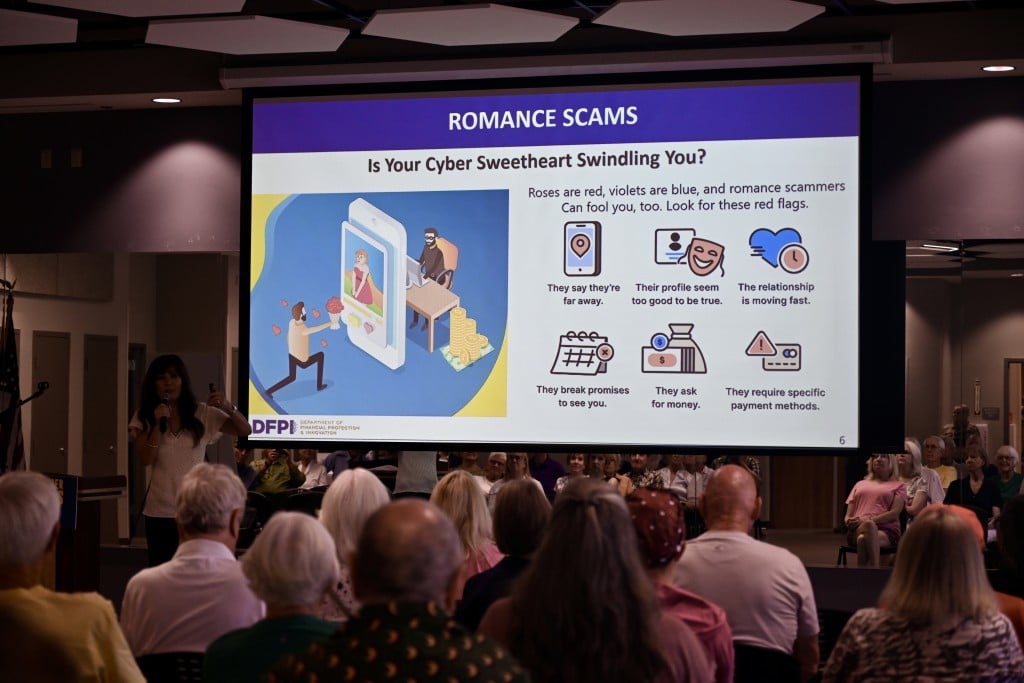
Wallis said that though the presentation was focused on individual steps to take for protection, “The legislature is obviously continuing to work on how we can put statute in place to better prosecute these scammers, better prevent them from happening,” he said.
“But as with so many things in government, we don’t move as quickly as what’s going on with technology.” He added that many scammers are part of large organized groups run from countries outside the jurisdiction of the U.S., making prosecution difficult.
Sally Westlake, the targeted outreach specialist for the California Department of Financial Protection and Innovation, highlighted one recent law, the Digital Financial Assets law, limiting cash deposits at physical crypto currency kiosks to $1,000 per person, per day.
Melissa Rosser with the California Privacy Protection Agency, told attendees that starting Aug. 1, the California Delete Act goes into effect, establishing the Delete Request and Opt-out Platform (DROP), where Californians can request the removal of their data from the 585 registered data brokers in the state.
Rosser explained that a data broker buys and sells personal information that they have gotten from other businesses, websites, or publicly available information. She called personal information “the new oil,” adding, “This is the currency driving the marketplace. It’s a multi-billion dollar industry and we think they are also the ones who are selling to a lot of scammers and fraudsters.”
“To want to shake a hand, to talk to someone, that is a beautiful human quality. We never want that to change in our society, but we also want you to be protected.”
— Kyra Hall
The scope of elder fraud continues to expand rapidly across both the state and the country. According to FBI crime data, Americans over the age of 60 lost $7.7 billion to fraud in 2025, representing a 30% increase from the previous year. Wallis said his office is getting an increase in constituents reaching out about scams.
In the face of an increasingly complex web of scams targeting almost every aspect of life, family members and victims often struggle to figure out where to turn for help. When asked about navigating disparate state and federal resources, Wallis advised using local legislative offices as a way to connect with regulators.
“Reach out to your local elected officials, your state, your general elected officials, whether that’s your assemblymember, your senator, your member of Congress, we have relationships with all these agencies,” Wallis said. “We can point you in the right direction.”
Officials and community members agreed that the root vulnerability at the heart of many of these schemes is a deeper societal epidemic of isolation and desire for connection.
Miedecke said at the beginning of the seminar that all it took for the scammer to target Whitaker was a simple post she had made mourning a friend. From there, the scammer pretended to know details about the friend and connected over what she thought were shared memories.
Wallis noted that addressing elder fraud requires looking beyond technical fixes toward broader community frameworks.
“I think that’s actually really a greater societal issue,” Wallis said, noting that technology has changed the ways people interact. “We’ve seen it with the advancements of technology…it’s really become easier to look inward, live a lot of your life online, and disconnect from face to face and real person interactions”.
Wallis urged residents to actively check on their loved ones and neighbors, emphasizing that protecting the community depends heavily on re-establishing real-world human connections.
Author

Related Articles

Coachella Valley Rescue Mission collecting backpacks, supplies for valley students ahead of new school year
The Coachella Valley Rescue Mission’s annual drive runs through Aug. 4, with a drive-thru distribution event set for Aug. 8 in Indio.

Indio moves to keep park restrooms open past 6 p.m. for evening games and practices
Indio officials are working to fix a scheduling mismatch that has been locking families out of facilities at South Jackson Park and the new Sports Park hours before evening activities end.

Indio plans drone show, polo grounds bash to celebrate Fourth of July
Indio is marking the nation’s semiquincentennial (250th anniversary) with a free celebration at the Empire Polo Grounds featuring live music, a kids’ zone, and a drone light show. Plus, you can dunk a local police officer for charity.