
City graffiti team takes proactive approach to combat tagging with daily patrols
The abatement team conducts daily self-initiated patrols and uses drone technology to locate and remove tagging, often before residents report it.
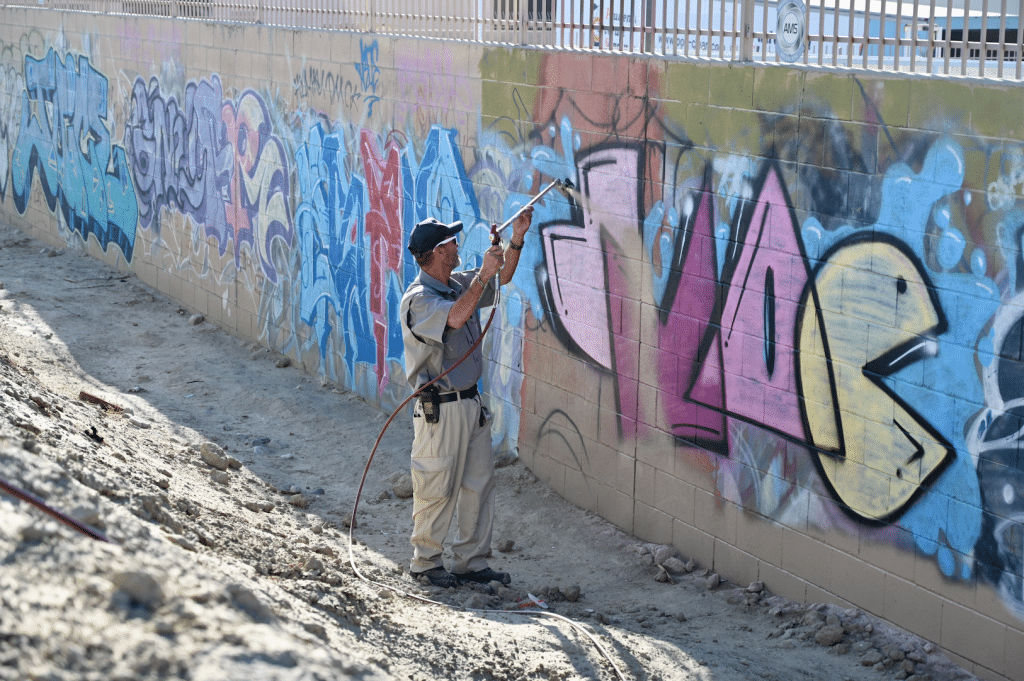
A city graffiti abatement team conducts daily self-initiated patrols throughout the community to locate and remove tagging, often even before residents report it.
Miguel Ramirez-Cornejo, the city’s director of economic development knows how important graffiti abatement is for the well-being of the city.
He said, “They’re almost like the Ghostbusters,” the way they pull up to a site in their work vehicle. Instead of busting ghosts, they’re busting huge swaths of graffiti on a daily basis.
They said Antonio “Tony” Munoz is particularly beloved for his passion for the craft of color-matching and the speed with which he eliminates the graffiti.
On Monday, he tackled a 450-foot wall behind Master Pools & Spas and Prudential Overall Supply on Trader Place and along the CV Link. He estimated it would take him about three hours, but he finished nearly a quarter of the wall in about 15 minutes.
Marketing and Public Information Officer for the city, Jessica Mediano, said when residents submit graffiti in the city’s app, if it’s on public property and on a weekday, it’s usually handled that day.
“It’s so cool, and you literally submit it in the app, and then my favorite thing is driving behind [them] and you just go, ‘Oh! It’s gone!’”
The team drives around the city identifying graffiti and cleaning it as part of their regular duties, supplementing citizen reports and police officer observations. The proactive approach allows the city to address vandalism quickly in a community where a staff of 300 serves more than 95,000 residents.
They stay busy, filling several work orders a day, totaling hundreds every year.
The city has incorporated drone technology to locate graffiti in hard-to-reach areas that would otherwise go unnoticed. Officials said the drones help save time by allowing crews to assess situations before returning with appropriate materials to address specific problems.
Sgt. Abe Plata, Indio Police Department’s public information officer said the majority of taggers are local residents who typically walk to their destinations carrying backpacks filled with spray paint colors. Much of the tagging is done to delineate gang territory or for taggers to show off their monikers and art.
Sgt. Plata said offenders start at a young age and continue until they mature and stop the behavior. Most don’t escalate to more serious offenses.
Juvenile offenders present particular challenges because parents typically pay fines rather than the offenders themselves, meaning young taggers don’t feel the full consequences of their actions. Some repeat offenders eventually stop when they grow tired of arrests and fines.
However, you won’t often see taggers messing with a mural. Sgt. Plata said they follow an unwritten rule against defacing murals, believing it brings bad luck.
Even Sgt. Plata admitted some of the taggers display artistic talent in their work, but it’s still vandalism that destroys the appearance of neighborhoods regardless of skill level.
At Wednesday’s City Council meeting, Councilmember Waymond Fermon suggested the city look into a sanctioned place where people could express themselves through graffiti, like the Kalamazoo Graffiti Wall or the Graffiti Yard in Downtown Palm Springs.
“It would assist in keeping their artwork off our buildings and [keep it off] residential areas,” he said.
Author

Related Articles

Indio Planning Commission delays vote on residential event ordinance after hours of deliberation
Planning commissioners voted 4-1 to continue the proposed permitting framework for weddings and parties, citing a need for more input from residents and event operators.

Homes in Indio are taking longer to sell than anywhere else in the Coachella Valley
Regional real estate data shows buyers are securing steeper discounts across the valley but overall sales remain 23% below historic averages.

Indio’s first independent bookstore coming to former Oasis on Miles music venue
The store would serve as a community-focused literary and cultural hub, hosting author events and arts programming while offering books and merchandise.